
Why We Decided to Create Model High Court Rules
If you work in a court, practise in a High Court, or have struggled as a litigant, this is for you. We are happy to announce the release of DAKSH's Model High Court Rules.

When I was asked to prepare Model High Court Rules, I thought the process would be a breeze. I had studied District Courts for more than two years. How different could High Court processes possibly be?
Turns out, the answer was: very different.
High Courts felt like stepping into a maze that someone had been renovating for 50 years without ever checking the original floor plan.
Inefficiency. But With a Personality.
When I started, a colleague, Aishwarya, showed me process maps she had spent months creating by talking to every single branch of the High Court we were studying at the time.
They looked like a spider web. I blinked. I rubbed my eyes. I blinked again.
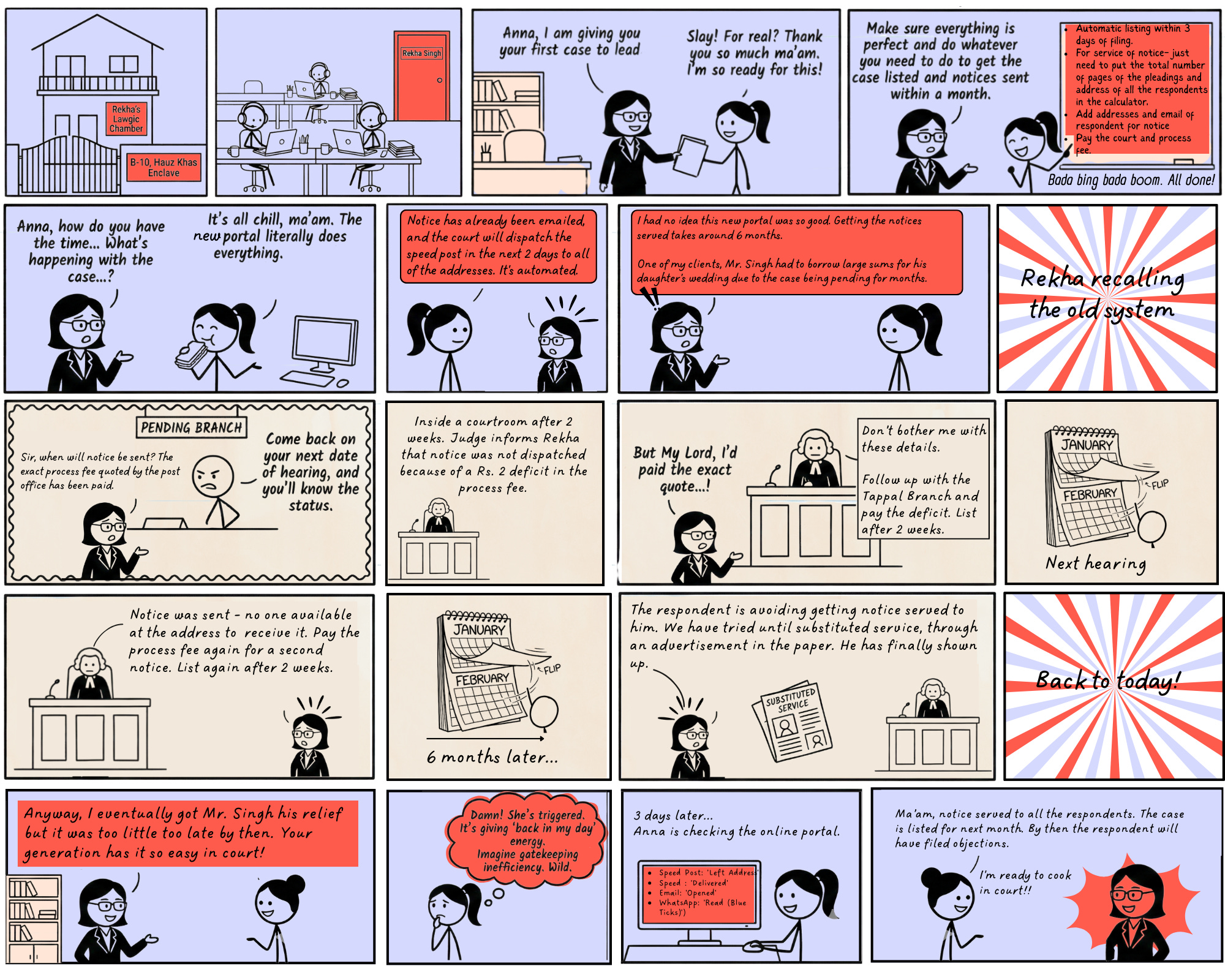
Steps led to sub-steps, which led to more steps, which somehow circled back to earlier steps. That’s when I realised how complex the processes really are. Take the example of sending a notice. It seemed to be a relay race between three different court branches and the post office. Lawyers physically carried heavy bundles from one end of the court to another, guessed how much postage to pay, and no one actually knew if the notice reached the other party until the next hearing date. In 2025.
Why We Decided to Create Model High Court Rules
At some point, we stopped asking, “Why is this process so complicated?” and started asking a more important question: How can this be fixed?
The answer: Redraft High Court Rules. High Court rules are supposed to ensure the smooth functioning of judicial processes and provide statutory backing to the overcomplicated processes. Over time, they have become archaic, confusing and inconsistent with technological advancements.
So instead of patching over cracks, we decided to rethink everything from scratch. We set out to create Model High Court Rules that are:
User-friendly
Faster
Logical
Actually compatible with the 21st century
If adopted, these rules could mean simple procedures that don’t require a PhD (or divine intervention) to understand. See the comic strip below to know our vision. Click on the image to expand.
Your Stories Matter!
If you work in a court, practise in a High Court, or have struggled as a litigant, we want to hear from you.
Tell us about:
The tiny daily annoyances
The invisible bottlenecks
The steps that make you stop and ask, “But… why?”
🔗 You can explore the project here: https://www.dakshindia.org/model-high-court-rules/
Since Rules are difficult to constantly amend, we have created the practice guidelines that are modular so that each High Court can customise details and amend them, as per their needs - https://www.dakshindia.org/wp-content/uploads/2025/12/High_Court_Practice_Directions.pdf
This is a working document. If you have any ideas or would like to discuss with us more on the issues, reach out to us at communications@dakshindia.org or atishya@dakshindia.org
Love this initiative! The spider web visualization of court processes really nails how legacy systems accumulate complexity. That relay race analogy for noitce distribution is spot on too. The modular practice guidelines idea is smart because it lets each court adapt without waiting for a full regulatory overhaul, which could take decades knowing how slow institutional change moves.